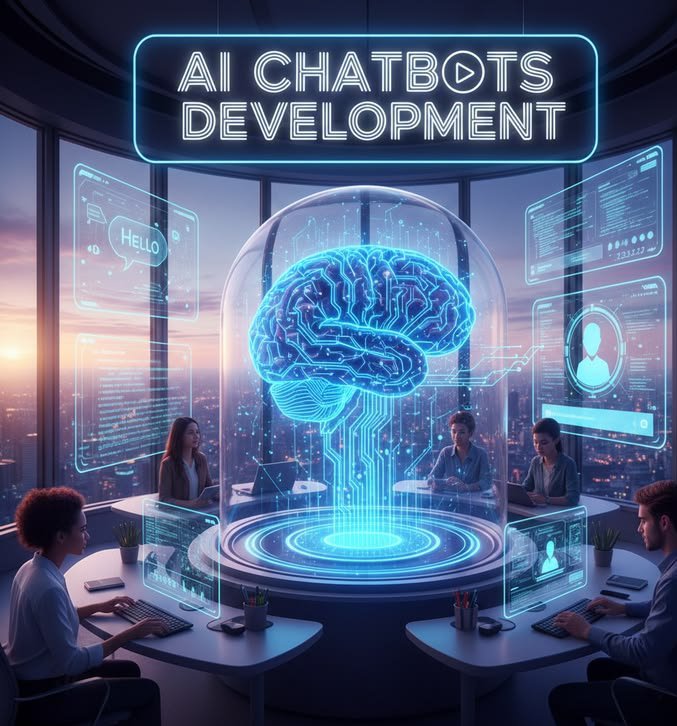
AI Chatbots work for:-
-
User Input – The user sends a message or question to the chatbot through text or voice.
-
Natural Language Processing (NLP) – The chatbot analyzes the message to understand the language, keywords, and user intent.
-
Intent Recognition – The system identifies what the user wants, such as asking a question, requesting information, or performing an action.
-
Processing the Request – The chatbot searches its knowledge base, database, or trained model to find the best response.
-
Response Generation – The system generates and sends an appropriate reply to the user.
-
Machine Learning Improvement – The chatbot learns from past interactions and improves its accuracy over time.
This process allows AI chatbots to provide quick, accurate, and automated responses, making them useful in many industries such as customer service, healthcare, banking, and education.
Technologies Used in AI Chatbot Development?
AI chatbot development relies on several advanced technologies that allow chatbots to understand human language, process information, and respond intelligently. These technologies work together to make chatbot conversations more natural, accurate, and efficient.
1. Artificial Intelligence (AI)
Artificial Intelligence is the core technology that enables chatbots to simulate human-like thinking and decision-making. AI chatbot development helps chatbots analyze user queries, understand patterns in data, and provide appropriate responses.
Key Points
-
Enables intelligent decision making
-
Helps chatbots understand user intent
-
Improves response accuracy
-
Supports automation of conversations
2. Natural Language Processing (NLP)
Natural Language Processing allows chatbots to understand and interpret human language. It helps the system analyze words, sentences, and context so that the chatbot can respond correctly to user questions.
Key Points
-
Understands human language and context
-
Identifies keywords and user intent
-
Processes text or voice inputs
-
Makes conversations more natural
3. Machine Learning (ML)
Machine Learning enables chatbots to learn from past conversations and improve their responses over time. The system uses data and training models to become more accurate and efficient.
Key Points
-
Learns from previous interactions
-
Improves chatbot performance over time
-
Helps recognize patterns in user queries
-
Provides more accurate responses
4. Speech Recognition and Text-to-Speech
Speech recognition technology allows chatbots to understand voice commands from users. Text-to-speech technology converts chatbot responses into spoken words, enabling voice-based interactions.
Key Points
-
Supports voice communication with users
-
Converts speech into text for processing
-
Converts text responses into voice output
-
Used in virtual assistants and voice bots
These technologies help create smart conversational systems that can interact with users effectively and provide useful information in real time.
Steps to Develop an AI Powered Chatbot?
There are some step to develop an AI Powered Chatbot:-
| Step |
Process |
Explanation |
| 1 |
Define the Purpose |
Identify the goal of the chatbot, such as customer support, answering questions, or providing information. |
| 2 |
Choose the Platform |
Decide where the chatbot will be used, such as websites, mobile apps, or messaging platforms. |
| 3 |
Design Conversation Flow |
Create conversation patterns and responses to guide how the chatbot interacts with users. |
| 4 |
Train the AI Model |
Use training data and NLP techniques to teach the chatbot how to understand and respond to user queries. |
| 5 |
Test the Chatbot |
Test different scenarios to check accuracy, fix errors, and improve chatbot performance. |
| 6 |
Deploy and Maintain |
Launch the chatbot for users and continuously monitor, update, and improve its functionality. |
There are some step to develop an AI Powered Chatbot.
Applications of AI Chatbots?
AI chatbots are widely used in many industries to improve communication, automate services, and provide quick assistance to users. These intelligent systems can handle multiple tasks such as answering questions, guiding users, and providing support. Because of their ability to operate 24/7 and respond instantly, AI chatbots have become an important tool for businesses and organizations.
1. Customer Service and Support
AI chatbots are commonly used in customer service to answer frequently asked questions and solve user problems quickly. They help businesses provide instant support without the need for human agents.
Key Points
- Answer customer queries instantly
- Provide product or service information
- Handle complaints and support requests
2. Healthcare Assistance
In healthcare, AI chatbots help patients by providing basic medical information, scheduling appointments, and sending medication reminders. They improve patient engagement and accessibility to healthcare services.
Key Points
- Provide health information and guidance
- Schedule doctor appointments
- Send medication reminders
3. E-commerce and Online Shopping
E-commerce platforms use chatbots to assist customers in finding products, tracking orders, and answering product-related questions. This improves the shopping experience.
Key Points
- Recommend products to customers
- Help track orders and deliveries
- Provide product details and offers
4. Education and Learning Support
Educational institutions use chatbots to help students with course information, exam schedules, and learning resources.
Key Points
- Provide academic information
- Answer student queries
- Support online learning platforms
5. Banking and Financial Services
Banks use AI chatbots to help customers check account balances, provide transaction details, and answer banking-related questions.
Key Points
- Provide account information
- Assist with transactions and payments
- Offer financial guidance
These applications show how AI chatbots help improve efficiency, communication, and user experience across different industries.
Benefits of AI Powered Chatbots
AI powered chatbots provide many advantages for businesses and users by improving communication, saving time, and automating routine tasks. These chatbots can interact with users in real time and provide quick responses to their queries. As a result, organizations can deliver better services while reducing operational costs.
1. 24/7 Availability
AI chatbots can work continuously without breaks, providing support to users at any time of the day. This ensures that customers can get help even outside normal working hours.
Key Points
- Available all day and night
- No waiting time for users
- Continuous customer support
2. Faster Response Time
Chatbots provide instant responses to user queries, which improves the overall user experience and satisfaction.
Key Points
- Immediate replies to questions
- Reduces waiting time for customers
- Improves service efficiency
3. Cost Reduction
By automating routine tasks, AI chatbots reduce the need for large customer support teams, which helps organizations save operational costs.
Key Points
- Automates repetitive tasks
- Reduces human workload
- Saves business expenses
4. Improved Customer Engagement
AI chatbots can interact with users in a friendly and personalized way, which helps keep customers engaged and satisfied.
Key Points
- Personalized responses
- Better interaction with users
- Enhances customer experience
5. Ability to Handle Multiple Users
Unlike human agents, chatbots can interact with many users at the same time without delays.
Key Points
- Handles multiple conversations simultaneously
- Suitable for large businesses and websites
- Improves service efficiency
Overall, AI powered chatbots help organizations provide faster, smarter, and more efficient services, making them an important part of modern digital communication systems.
Conclusion
AI powered chatbot development plays an important role in modern digital communication. These intelligent systems help organizations interact with users in a faster, smarter, and more efficient way. By using technologies such as Artificial Intelligence (AI), Natural Language Processing (NLP), and Machine Learning (ML), chatbots can understand user queries and provide accurate responses in real time.
AI chatbots are widely used in different industries such as customer service, healthcare, education, banking, and e-commerce. They help automate routine tasks, provide instant support, and improve user engagement. Businesses benefit from chatbots because they reduce operational costs, increase efficiency, and provide 24/7 assistance to customers.
Although AI chatbots offer many advantages, there are still some challenges such as understanding complex queries and ensuring data privacy. However, with continuous technological advancements, chatbots are becoming more intelligent and capable of providing better user experiences.
Key Points
- Improve communication between businesses and users
- Provide quick and automated responses
- Reduce workload and operational costs
- Support multiple industries and applications
- Will become more advanced in the future
In conclusion, AI chatbots development are transforming the way people interact with digital systems. As technology continues to evolve, these smart conversational systems will become even more powerful and widely used in the future.
Also ,check thishttps://cswebexperts.com/clawdbot-ai-writing-assistant-guide/
ClawdBot – Your AI Writing Assistant Explained