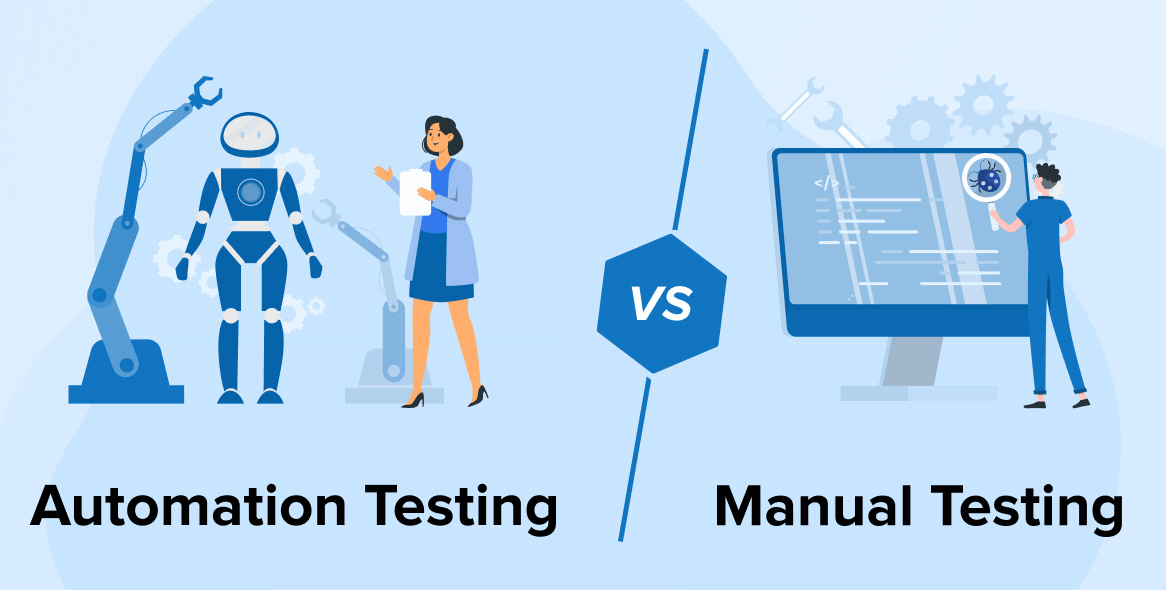
Manual Testing vs Automation Testing: Understanding the Real Difference
Software quality decides whether users trust an application or uninstall it within minutes. Behind every reliable app, there is a strong testing strategy. When it comes to testing, one question often confuses beginners and even professionals: manual testing vs automation testing – which is better?
The truth is, neither approach is “better” in all situations. Both manual and automation testing play important roles in the software development lifecycle. In this blog, we’ll break down the difference between manual testing and automation testing in simple terms and help you understand when and why to use each.
What Is Manual Testing in Software Testing?
Manual testing is a process where a human tester checks the software manually without using automated tools. The tester follows test cases, explores features, clicks buttons, fills forms, and observes the behavior of the application.
This type of testing closely simulates how real users interact with the product.
Common Types of Manual Testing
-
Smoke Testing
-
Sanity Testing
-
Exploratory Testing
-
Usability Testing
-
Ad-hoc Testing
Manual testing is especially useful in the early stages of development when the application is still changing frequently.
Benefits of Manual Testing
-
Easy to learn for beginners
-
No need for coding knowledge
-
Best for UI and UX testing
-
More flexible for changing requirements
Drawbacks of Manual Testing
-
Takes more time
-
Not suitable for repetitive tasks
-
Prone to human mistakes
-
Difficult to scale for large projects
What Is Automation Testing?
Automation testing is a testing technique where test cases are executed automatically using scripts and tools. Instead of testing the same features repeatedly by hand, testers write automation scripts that run tests faster and more accurately.
Automation testing is widely used in modern Agile and DevOps environments.
Popular Automation Testing Tools
-
Selenium
-
Cypress
-
TestNG
-
Playwright
-
Appium
Benefits of Automation Testing
-
Faster test execution
-
High accuracy and consistency
-
Ideal for regression testing
-
Saves long-term cost
Limitations of Automation Testing
-
High initial setup cost
-
Requires programming skills
-
Not suitable for usability testing
-
Scripts need maintenance when UI changes
.
Manual Testing vs Automation Testing: Key Differences
| Feature | Manual Testing | Automation Testing |
|---|---|---|
| Execution | Done by humans | Done by tools |
| Speed | Slow | Very fast |
| Cost | Low initial cost | High initial cost |
| Accuracy | Depends on tester | Highly accurate |
| Best For | UI & exploratory testing | Regression & performance testing |
| Skill Required | Basic testing knowledge | Testing + coding skills |
When Should You Use Manual Testing?
Manual testing is the best choice in situations where:
-
The application is new
-
Test cases change frequently
-
User experience is critical
-
Budget is limited
-
One-time testing is required
For example, if you are testing a new website layout or checking content readability, manual testing is more effective.
👉 You can also read our guide on software testing fundamentals (internal link).
When Should You Use Automation Testing?
Automation testing works best when:
-
Test cases are repetitive
-
The project is long-term
-
Regression testing is frequent
-
Large data sets are involved
-
Continuous integration is required
In large enterprise applications, automation helps teams save time and release updates faster.
According to industry experts, automation testing improves productivity significantly (external link).
Can Manual and Automation Testing Work Together?
Yes, and in real projects, they usually do.
A smart testing strategy combines both approaches:
-
Manual testing for exploratory and UI testing
-
Automation testing for regression and repetitive tasks
This hybrid approach ensures better quality, faster delivery, and lower risk.
If you’re preparing for a QA role, understanding both methods is essential. You may also find our article on manual testing interview questions helpful (internal link).
Career Scope: Manual vs Automation Testing
For beginners, manual testing is the best entry point into software testing. Over time, learning automation tools and scripting languages like Java or Python can open better career opportunities.
Automation testers often earn higher salaries due to their technical expertise and demand in the market (external link).
Final Thoughts
The debate around manual testing vs automation testing should not be about choosing one over the other. Instead, it should be about understanding where each fits best.
Manual testing brings human insight, while automation testing brings speed and reliability. Together, they create a powerful testing strategy that ensures software quality and user satisfaction.
If you’re learning software testing or planning a career in IT, mastering both approaches will give you a strong advantage.